IAML Unit 3: Dicussion

Announcements

  • Feedback - THANKS!
    • consistent feedback will be implemented (as best I can!)
    • people definitely want summaries of units and comparisons of algorithms
  • Ames regression due Friday
    • Winner announced in discussion next week!
  • Homework is basically same for unit 4
    • New dataset - titanic
    • Do EDA but we don’t need to see it
    • Fit KNN and RDA models (will learn about LDA, QDA and RDA in unit)
    • Submit predictions. Free lunch!

Held-in and held-out data

Connect to training, validation, and test sets

Held in and held out data

  • fit models
  • select best configurations
  • calculate performance metric

Why need held-out

  • Example: Selecting best k - train vs validation data

KNN Overview

View slides

  • How does KNN use training data to make predictions
  • What is k and how does it get used when making predictions?
  • What is the impact of k on bias and variance/overfitting?
  • k=1: performance in train? in val?
  • Distance measures: use Euclidean (default in kknn)!
  • Tuning K efficiently: stay “tuned”

Interaction in KNN - Consider bias first (but also variance) in this example

  • Simulate data
  • Fit models for lm and knn with and without interaction
  • Took some shortcuts (no recipe, predict back into train)
Code
library(tidymodels)
n <- 200
set.seed(5433)

d <- tibble(x1 = runif(n, 0,100), # uniform
               x2 = rep(c(0,1), n/2), # dichotomous
               x1_x2 = x1*x2, # interaction
               y = rnorm(n, 0 + 1*x1 + 10*x2 + 10* x1_x2, 20)) #DGP + noise

fit_lm <- 
  linear_reg() |>   
  set_engine("lm") |>   
  fit(y ~ x1 + x2, data = d)

fit_lm_int <- 
  linear_reg() |>   
  set_engine("lm") |>   
  fit(y ~ x1 + x2 + x1_x2, data = d)

fit_knn <- 
  nearest_neighbor(neighbors = 20) |>   
  set_engine("kknn") |>   
  set_mode("regression") |> 
  fit(y ~ x1 + x2, data = d)

fit_knn_int <- 
  nearest_neighbor(neighbors = 20) |>   
  set_engine("kknn") |>   
  set_mode("regression") |> 
  fit(y ~ x1 + x2 + x1_x2, data = d)

d <- d |> 
  mutate(pred_lm = predict(fit_lm, d)$.pred,
         pred_lm_int = predict(fit_lm_int, d)$.pred,
         pred_knn = predict(fit_knn, d)$.pred,
         pred_knn_int = predict(fit_knn_int, d)$.pred)
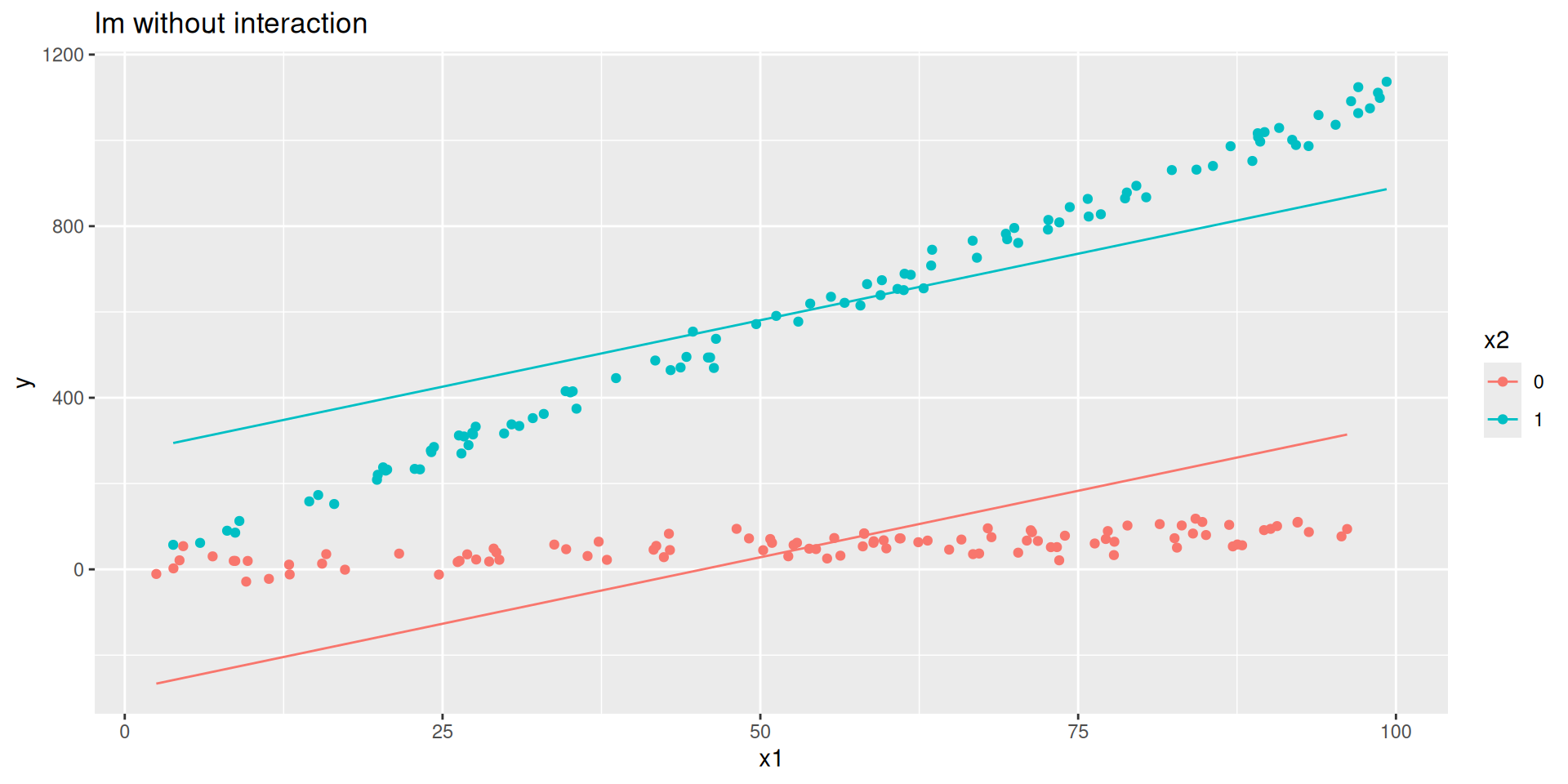
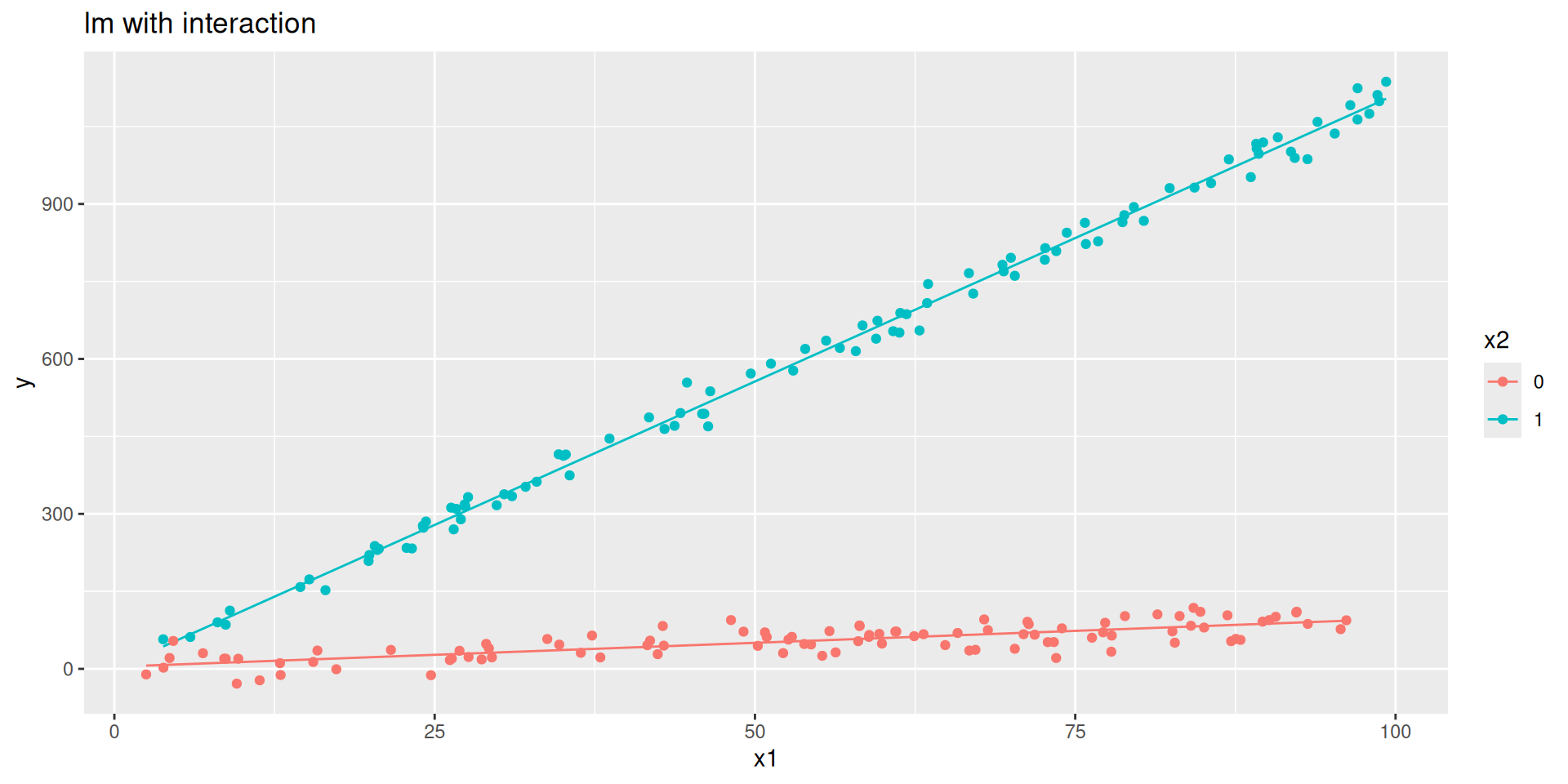
  • Predictions from linear model with and without interaction
    • You NEED interaction features with LM
Code
d |> 
  ggplot(aes(x = x1, group = factor(x2), color = factor(x2))) +
    geom_line(aes(y = pred_lm)) +
    geom_point(aes(y = y)) +
    ggtitle("lm without interaction") +
    ylab("y") +
    scale_color_discrete(name = "x2")

Code
d |> 
  ggplot(aes(x = x1, group = factor(x2), color = factor(x2))) +
    geom_line(aes(y = pred_lm_int)) +
    geom_point(aes(y = y)) +
    ggtitle("lm with interaction") +
    ylab("y") +
    scale_color_discrete(name = "x2")

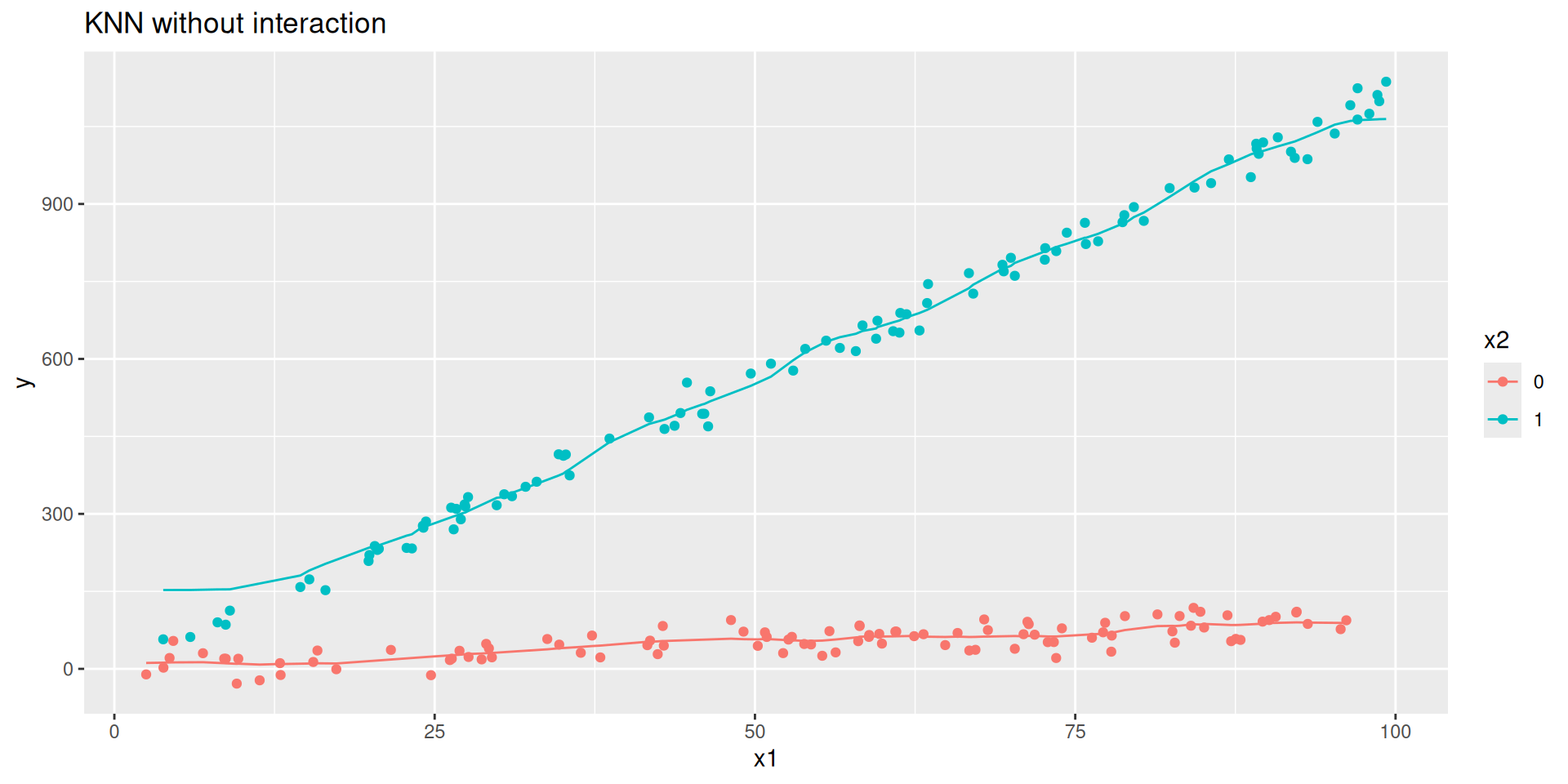
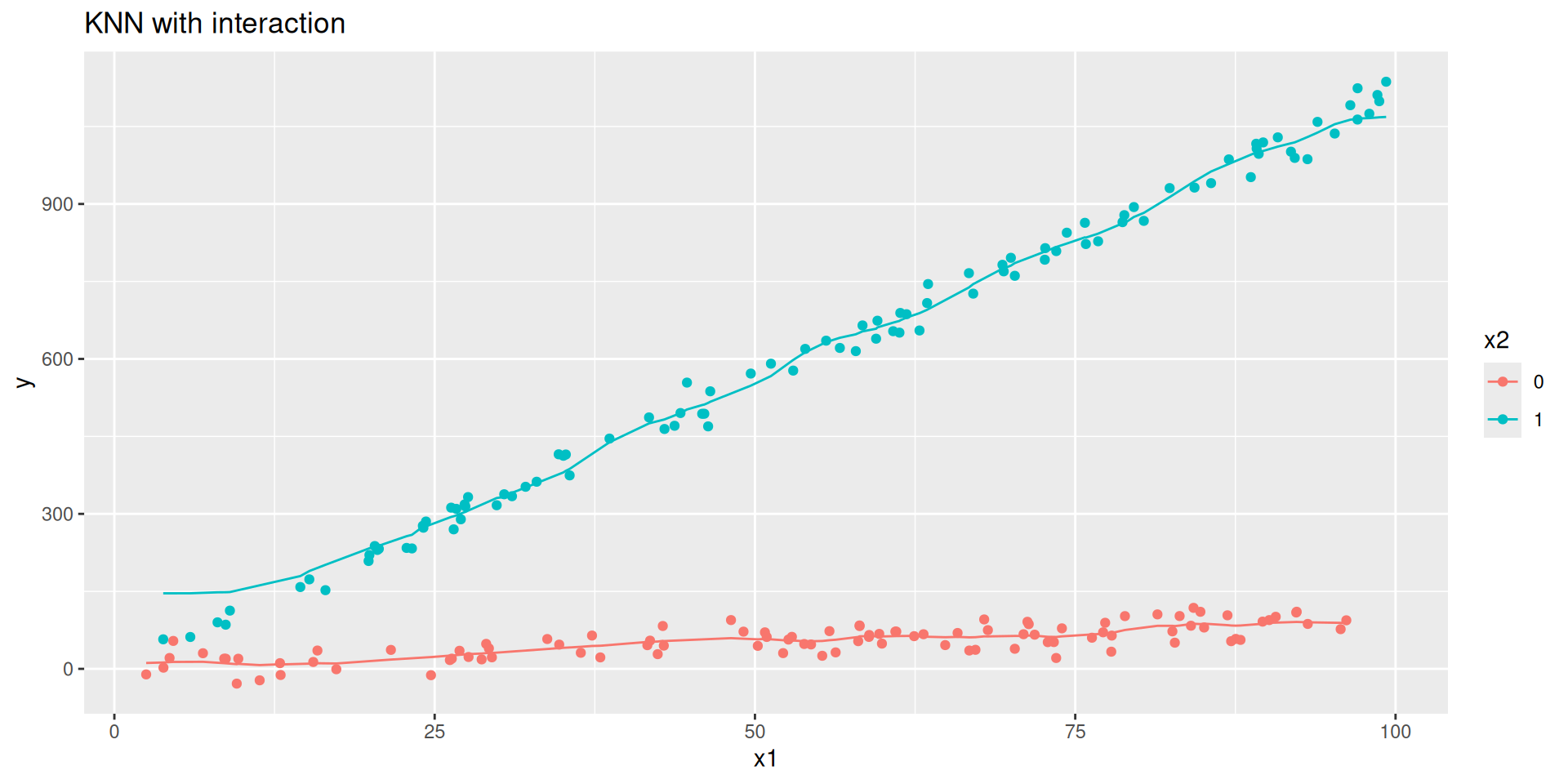
  • Predictions from KNN with and without interaction
    • You do NOT need interaction features with KNN!
Code
d |> 
  ggplot(aes(x = x1, group = factor(x2), color = factor(x2))) +
    geom_line(aes(y = pred_knn)) +
    geom_point(aes(y = y)) +
    ggtitle("KNN without interaction") +
    ylab("y") +
    scale_color_discrete(name = "x2")

Code
d |> 
  ggplot(aes(x = x1, group = factor(x2), color = factor(x2))) +
    geom_line(aes(y = pred_knn_int)) +
    geom_point(aes(y = y)) +
    ggtitle("KNN with interaction") +
    ylab("y") +
    scale_color_discrete(name = "x2")

KNN assumptions

Euclidean distance assumes:

  • Each feature is independent
  • Each dimension contributes new, unique information
  • Moving one unit along any axis is equally meaningful

KNN also makes locality (smoothness) assumption

KNN also requires sufficient data density (i.e., covers the feature space)

KNN works best with low dimensional data (few features) because distance becomes less meaningful/discriminating in high dimensions. PCA can help.

GLM assumptions

What are GLM assumptions and what happens if violated

  • Measurement error

  • Independent

  • Normal

    • Consequence: lm parameter estimates still unbiased (for linear DGP) but more “efficient” solutions exist
    • Bad for prediction b/c higher variance than other solutions
    • May suggest omission of variables
  • Constant

    • Consequence: Inefficient and inaccurate standard errors.
    • Statistical tests wrong
    • Poor prediction for some (where larger variance of residuals) \(\hat{y}\)
    • higher variance overall than other solutions - bad again for prediction
  • Linear

    • Residuals do not have mean of 0 for every \(\hat{y}\)
    • Consequence: biased parameter estimates. Linear is bad DGP
    • Also bad test of questions RE the predictor (underestimate? misinform)

Use of plot_truth() [predicted vs. observed] to assess latter three assumptions

Transformations of numeric predictors

Normalizing transformations - Yeo Johnson

  • when needed for lm?

  • when needed for knn?

  • Transformation of outcome?

    • metric
    • back to raw predictions

Bias and Variance of estimates

Bias and variance- general

  • property of any estimate
  • for now, we will focus on model (and its \(\hat{Y}\))
  • Describe each

Bias bias and variance - glm vs knn

Bias and variance - k in knn?

Impact of correlated features

  • in GLM
  • in KNN
  • PCA? Drop correlated features?

LM vs. KNN better with some predictors or overall?

  • “Why do some features seem to improve performance more in linear models or only in KNNs?”
  • “What are some contexts where KNN doesn’t work well? In other words, what are the advantages/disadvantages of using KNN?”
    • Always comes down to bias vs. variance
    • Flexibility and N are key moderators of these two key factors.
    • k? - impact on bias, variance?
  • KNN for explanation?
    • Visualizations (think of interaction plot above) make clear the effect
    • Will learn more (better visualizations, variable importance, model comparisons) in later unit

Categorical coding

  • Why do we do it? (Not need for every algorithm!)
  • Describe the values assigned to the dummy coded features
  • Why these values? In other words, how can you interpret the effect of a dummy coded feature?
  • “Dummy variable trap”
  • How is it different from one-hot coding. When to use or not use one-hot coding?
  • Other methods
    • Ordinal coding
    • Target (mean) encoding
    • frequency coding

Performance metrics

  • SSE, MSE, RMSE, MAE, R2
  • How else are SSE class of metrics used in glm?

Exploration

  • “I feel that I can come up with models that decrease the RMSE, but I don’t have good priors on whether adding any particular variable or observation will result in an improved model. I still feel a little weird just adding and dropping variables into a KNN and seeing what gets the validation RMSE the lowest (even though because we’re using validation techniques it’s a fine technique)”
    • Exploration is learning. This is research. If you knew the answer you wouldn’t be doing the study
    • Domain knowledge is still VERY important
    • Some algorithms (LASSO, glmnet) will help with feature selection
    • staying organized
      • Script structure
      • Good documentation - QMD as analysis notebook
    • Some overfitting to validation will occur? Consequence? Solutions?

“Curse of dimensionality” - Bias vs. variance

  • Missing features produce biased models.
  • Unnecessary features or even many features relative to N produce variance
  • Does your available N in your algorithm support the features you need to have low bias.
    • Mostly an empirical question - can’t really tell otherwise outside of simulated data. Validation set is critical!
    • Flexible models often need more N holding features constant
    • Regularization (unit 6) will work well when lots of features

Sources of error

  • What are two broad sources of error?
  • What are two broad sources of reducible error. Describe what they are and factors that affect them?
  • Why do we need independent validation data to select the best model configuration?
  • Why do we need test data if we used validation data to select among many model configurations
  • What is RMSE? Connect it to metric you already know? How is it being used in lm (two ways)?; in knn (one way)?
  • How does bias and variance manifest when you look at your performance metric (RMSE) in training and validation sets?
  • Will the addition of new features to a (lm?) model always reduce RMSE in train? in validation? Connect to concepts of bias and variance

“In GLM, why correlation/collinearity among predictors will cause larger variance? Is it because of overfitting?”

KNN (black box) for explanatory purposes